How Non-Tax-Paying Entities Can Unlock Stranded Clean Energy ITC Financing Post-OB3
How Non-Tax-Paying Entities Can Unlock Stranded Clean Energy ITC Financing Post-OB3
Jan 20, 2026
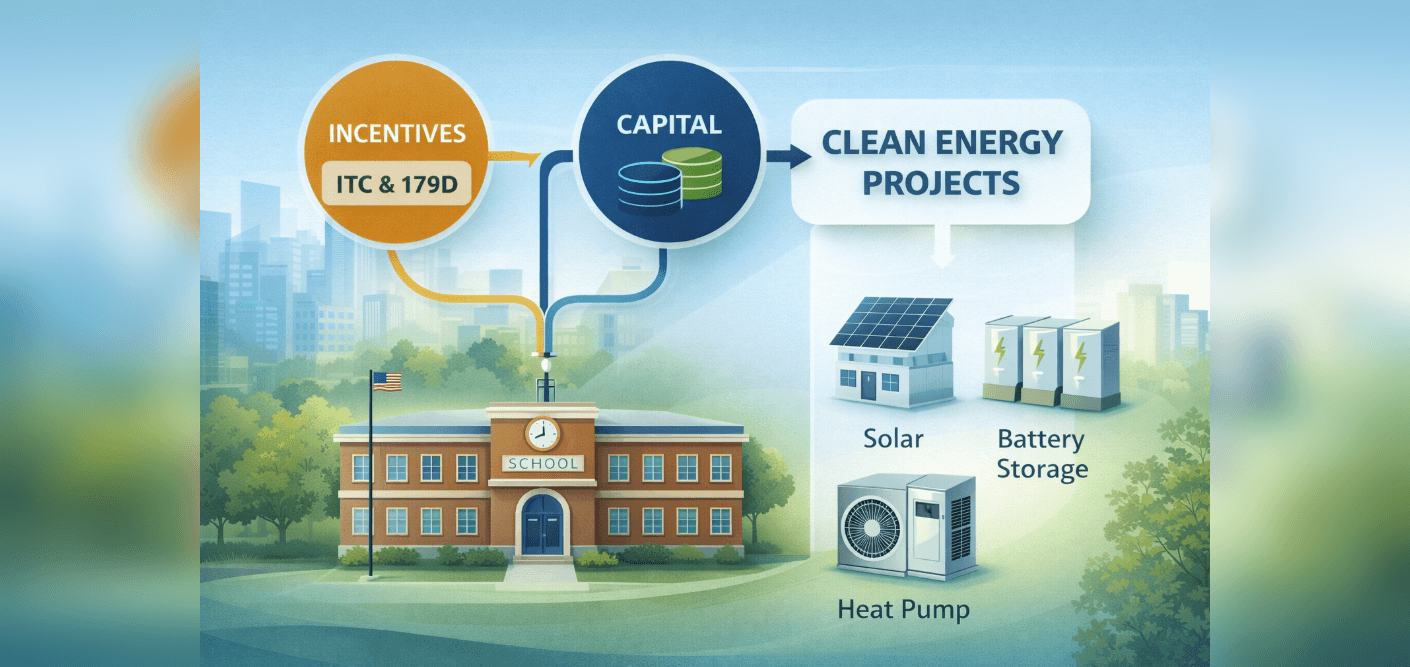
The MUSH and Non-Tax-Paying Entity Clean Energy Dilemma
The second half of 2025 brought seismic changes to clean energy financing in the United States. For non-tax-paying entities—including municipalities, universities, schools, hospitals, housing authorities, tribal governments, and nonprofit organizations (often referred to collectively as the MUSH market)—the promise of clean energy investment through tax incentives has become significantly more complex and materially riskier.
Legislative and regulatory changes commonly referred to as the One Big Beautiful Bill (OB3) reshaped the compliance and risk landscape. While non-tax-paying entities retained access to Direct Pay, allowing tax credits to be monetized as cash payments, new compliance requirements, expanded recapture triggers, and sharply higher insurance costs have left billions of dollars of otherwise viable clean energy projects stranded.
What was once a financing accelerator has, in many cases, become a gating risk.
Understanding the Stakes: Tax Credits as the Foundation
Investment Tax Credits (ITCs) have been the cornerstone of renewable energy financing for decades. The baseline ITC provides a 30% credit, which can increase meaningfully through bonus provisions related to domestic content, energy-community siting, and prevailing wage and apprenticeship requirements. In aggregate, tax incentives can represent 30–70% of total project capital expenditures when properly structured and stacked.
For non-tax-paying entities in particular, Direct Pay preserved access to the full economic value of these credits without relying on complex tax equity structures. This was transformative. A school district or housing authority could deploy solar, storage, or efficiency upgrades and receive a direct payment from the IRS, allowing projects to “pencil” financially without Wall Street intermediaries.
Incentives Are Evolving — Not Disappearing
Importantly, not all clean energy incentives are sunsetting. While some ITC pathways require Safe Harbor treatment to lock in eligibility, other incentive streams—such as those supporting high-efficiency heat pumps, electrification, and building efficiency measures—continue to offer benefits that can approach 50% of project CapEx, particularly when layered with efficiency and bonus provisions.
This creates two parallel realities:
A near-term opportunity to Safe Harbor projects and mitigate Direct Pay recapture risk
A longer-term value stream of continuing incentives that must be efficiently integrated into capital structures that trust the underlying data
In both cases, the challenge is the same: incentives only function as capital when compliance and eligibility can be demonstrated with confidence over time.
But OB3 Changed the Risk Equation
OB3 introduced a cascade of compliance-driven risks that have materially altered how clean energy projects are underwritten and financed for non-tax-paying entities.
The 10-Year Recapture Sword of Damocles
The most severe provision is the 100% ITC clawback tied to Foreign Entities of Concern (FEOC). For projects placed in service beginning in 2028, a single prohibited payment to an entity linked to China, Russia, Iran, or North Korea during a ten-year compliance window can trigger full credit recapture.
For a university installing a $50 million solar system supported by a $15 million ITC, this means that every supplier relationship, component replacement, licensing agreement, and service contract must remain compliant for a decade. One misstep—and the entire credit is recaptured.
Accuracy-Related Penalties with Lowered Thresholds
OB3 imposes a 20% penalty on mis-claimed credits and lowers the accuracy-related penalty threshold to a 1% understatement for corporations. For non-tax-paying entities navigating complex supply chains and documentation requirements, the margin for error has effectively vanished.
Supplier Certification Landmines
New penalties target inaccurate certifications related to material sourcing and supply-chain disclosures. Developers and asset owners face penalties equal to the greater of 10% of the tax underpayment or $5,000 for certifications they “reasonably should have known” were inaccurate—an extremely high standard in globally sourced energy systems.
Extended IRS Review Period
The statute of limitations for IRS challenges related to FEOC determinations has expanded from three to six years, extending uncertainty long after projects are placed in service.
The Potential Balance Sheet Impact
From a public-finance perspective, ITC recapture risk now represents a material contingent liability that must be evaluated, disclosed, and in some cases indemnified.
Bond counsel—tasked with protecting tax-exempt status and disclosure integrity—are increasingly treating incentive exposure as a credit issue, not merely a project issue. The implications are significant:
Liability Recognition: Potential recapture amounts may need to be evaluated under GASB standards if deemed probable and estimable
Financial Strain: A recapture event creates an immediate, unbudgeted liability
Bond Rating Pressure: Unexpected liabilities can trigger rating reviews or downgrades, increasing borrowing costs across all municipal financing
Disclosure Burden: Incentive risk must be disclosed in offering documents, reducing appetite among conservative investors
For many school districts and municipalities, these balance-sheet considerations alone are deal-killers—even when project economics otherwise make sense.
The Insurance Market’s Repricing Shock
Before OB3, ITC recapture insurance was a niche product priced at 1–2% of credit value. Post-OB3, insurers have repriced aggressively:
Unverified projects: 5–8% of credit value, or no coverage at any price
Example:
$50M project with $15M ITC
Pre-OB3 premium: $150K–$300K
Post-OB3 (unverified): $750K–$1.2M
This repricing alone destroys project economics for a large portion of the non-tax-paying entity market.
The Result: Stranded Tax Credits
Non-tax-paying entities now face a paradox:
Incentives are legally available
Projects are technically eligible
Capital exists
But compliance uncertainty and insurance costs make financing infeasible
Billions of dollars in clean energy tax credits are stranded—available in statute, but inaccessible in practice.
The Realizse Solution: Verified Data as the Bridge to Capital
The core issue is not regulation. It is verification.
Legacy compliance approaches—PDFs, email chains, static certifications—cannot satisfy post-OB3 underwriting, audit, and insurance requirements.
Realizse addresses this through the Realizse Passport: a unified, tamper-proof, cryptographically verifiable system of record that transforms fragmented compliance data into insurance-ready, capital-grade assets.
How It Works
Validated Asset Data
Real-time and static data are integrated to provide full traceability from manufacturer through operation.Automated Insurance Integration
Verified data flows directly to underwriters, enabling materially lower premiums for verifiable projects.Continuous Audit Readiness
Machine-readable compliance records support instant response to IRS or insurer inquiries.Bond Counsel Confidence
Risk can be quantified, disclosed, and structured—rather than avoided.
Beyond Compliance: A Durable Advantage
Entities that adopt verified compliance infrastructure do more than mitigate risk:
Projects move faster
Insurance costs stabilize
Bond ratings are protected
Capital engages with confidence
In the post-OB3 environment, verification is the new prerequisite for clean energy finance.
The Path Forward
OB3 raised the bar. It did not eliminate opportunity.
Non-tax-paying entities that can integrate both Safe Harbor opportunities and continuing incentive programs into trusted, insurable capital structures will unlock clean energy financing while others remain constrained.
Clean energy incentives remain powerful.
The difference now is clear:
Only verifiable incentives—sunsetting or not—are financeable.
Ready to Unlock Stranded Incentive Value?
If compliance risk or insurance pricing is limiting your ability to finance clean energy projects, a short assessment can help identify a path forward.
In 20 minutes, we can evaluate:
Incentive exposure and recapture risk
Insurance and disclosure considerations
Opportunities to convert incentive value into financeable capital
Schedule an assessment to determine how your projects can proceed here: https://calendar.app.google/4ZTcDsnh52MbCYrV8
The MUSH and Non-Tax-Paying Entity Clean Energy Dilemma
The second half of 2025 brought seismic changes to clean energy financing in the United States. For non-tax-paying entities—including municipalities, universities, schools, hospitals, housing authorities, tribal governments, and nonprofit organizations (often referred to collectively as the MUSH market)—the promise of clean energy investment through tax incentives has become significantly more complex and materially riskier.
Legislative and regulatory changes commonly referred to as the One Big Beautiful Bill (OB3) reshaped the compliance and risk landscape. While non-tax-paying entities retained access to Direct Pay, allowing tax credits to be monetized as cash payments, new compliance requirements, expanded recapture triggers, and sharply higher insurance costs have left billions of dollars of otherwise viable clean energy projects stranded.
What was once a financing accelerator has, in many cases, become a gating risk.
Understanding the Stakes: Tax Credits as the Foundation
Investment Tax Credits (ITCs) have been the cornerstone of renewable energy financing for decades. The baseline ITC provides a 30% credit, which can increase meaningfully through bonus provisions related to domestic content, energy-community siting, and prevailing wage and apprenticeship requirements. In aggregate, tax incentives can represent 30–70% of total project capital expenditures when properly structured and stacked.
For non-tax-paying entities in particular, Direct Pay preserved access to the full economic value of these credits without relying on complex tax equity structures. This was transformative. A school district or housing authority could deploy solar, storage, or efficiency upgrades and receive a direct payment from the IRS, allowing projects to “pencil” financially without Wall Street intermediaries.
Incentives Are Evolving — Not Disappearing
Importantly, not all clean energy incentives are sunsetting. While some ITC pathways require Safe Harbor treatment to lock in eligibility, other incentive streams—such as those supporting high-efficiency heat pumps, electrification, and building efficiency measures—continue to offer benefits that can approach 50% of project CapEx, particularly when layered with efficiency and bonus provisions.
This creates two parallel realities:
A near-term opportunity to Safe Harbor projects and mitigate Direct Pay recapture risk
A longer-term value stream of continuing incentives that must be efficiently integrated into capital structures that trust the underlying data
In both cases, the challenge is the same: incentives only function as capital when compliance and eligibility can be demonstrated with confidence over time.
But OB3 Changed the Risk Equation
OB3 introduced a cascade of compliance-driven risks that have materially altered how clean energy projects are underwritten and financed for non-tax-paying entities.
The 10-Year Recapture Sword of Damocles
The most severe provision is the 100% ITC clawback tied to Foreign Entities of Concern (FEOC). For projects placed in service beginning in 2028, a single prohibited payment to an entity linked to China, Russia, Iran, or North Korea during a ten-year compliance window can trigger full credit recapture.
For a university installing a $50 million solar system supported by a $15 million ITC, this means that every supplier relationship, component replacement, licensing agreement, and service contract must remain compliant for a decade. One misstep—and the entire credit is recaptured.
Accuracy-Related Penalties with Lowered Thresholds
OB3 imposes a 20% penalty on mis-claimed credits and lowers the accuracy-related penalty threshold to a 1% understatement for corporations. For non-tax-paying entities navigating complex supply chains and documentation requirements, the margin for error has effectively vanished.
Supplier Certification Landmines
New penalties target inaccurate certifications related to material sourcing and supply-chain disclosures. Developers and asset owners face penalties equal to the greater of 10% of the tax underpayment or $5,000 for certifications they “reasonably should have known” were inaccurate—an extremely high standard in globally sourced energy systems.
Extended IRS Review Period
The statute of limitations for IRS challenges related to FEOC determinations has expanded from three to six years, extending uncertainty long after projects are placed in service.
The Potential Balance Sheet Impact
From a public-finance perspective, ITC recapture risk now represents a material contingent liability that must be evaluated, disclosed, and in some cases indemnified.
Bond counsel—tasked with protecting tax-exempt status and disclosure integrity—are increasingly treating incentive exposure as a credit issue, not merely a project issue. The implications are significant:
Liability Recognition: Potential recapture amounts may need to be evaluated under GASB standards if deemed probable and estimable
Financial Strain: A recapture event creates an immediate, unbudgeted liability
Bond Rating Pressure: Unexpected liabilities can trigger rating reviews or downgrades, increasing borrowing costs across all municipal financing
Disclosure Burden: Incentive risk must be disclosed in offering documents, reducing appetite among conservative investors
For many school districts and municipalities, these balance-sheet considerations alone are deal-killers—even when project economics otherwise make sense.
The Insurance Market’s Repricing Shock
Before OB3, ITC recapture insurance was a niche product priced at 1–2% of credit value. Post-OB3, insurers have repriced aggressively:
Unverified projects: 5–8% of credit value, or no coverage at any price
Example:
$50M project with $15M ITC
Pre-OB3 premium: $150K–$300K
Post-OB3 (unverified): $750K–$1.2M
This repricing alone destroys project economics for a large portion of the non-tax-paying entity market.
The Result: Stranded Tax Credits
Non-tax-paying entities now face a paradox:
Incentives are legally available
Projects are technically eligible
Capital exists
But compliance uncertainty and insurance costs make financing infeasible
Billions of dollars in clean energy tax credits are stranded—available in statute, but inaccessible in practice.
The Realizse Solution: Verified Data as the Bridge to Capital
The core issue is not regulation. It is verification.
Legacy compliance approaches—PDFs, email chains, static certifications—cannot satisfy post-OB3 underwriting, audit, and insurance requirements.
Realizse addresses this through the Realizse Passport: a unified, tamper-proof, cryptographically verifiable system of record that transforms fragmented compliance data into insurance-ready, capital-grade assets.
How It Works
Validated Asset Data
Real-time and static data are integrated to provide full traceability from manufacturer through operation.Automated Insurance Integration
Verified data flows directly to underwriters, enabling materially lower premiums for verifiable projects.Continuous Audit Readiness
Machine-readable compliance records support instant response to IRS or insurer inquiries.Bond Counsel Confidence
Risk can be quantified, disclosed, and structured—rather than avoided.
Beyond Compliance: A Durable Advantage
Entities that adopt verified compliance infrastructure do more than mitigate risk:
Projects move faster
Insurance costs stabilize
Bond ratings are protected
Capital engages with confidence
In the post-OB3 environment, verification is the new prerequisite for clean energy finance.
The Path Forward
OB3 raised the bar. It did not eliminate opportunity.
Non-tax-paying entities that can integrate both Safe Harbor opportunities and continuing incentive programs into trusted, insurable capital structures will unlock clean energy financing while others remain constrained.
Clean energy incentives remain powerful.
The difference now is clear:
Only verifiable incentives—sunsetting or not—are financeable.
Ready to Unlock Stranded Incentive Value?
If compliance risk or insurance pricing is limiting your ability to finance clean energy projects, a short assessment can help identify a path forward.
In 20 minutes, we can evaluate:
Incentive exposure and recapture risk
Insurance and disclosure considerations
Opportunities to convert incentive value into financeable capital
Schedule an assessment to determine how your projects can proceed here: https://calendar.app.google/4ZTcDsnh52MbCYrV8
