Treasury’s FEOC Guidance Raises the Bar on Clean Energy Compliance — and the Need for Insurable Infrastructure
Treasury’s FEOC Guidance Raises the Bar on Clean Energy Compliance — and the Need for Insurable Infrastructure
Feb 13, 2026
The U.S. Treasury and IRS recently released Notice 2026-15, providing initial guidance on the “Foreign Entity of Concern” (FEOC) provisions under the One Big Beautiful Bill Act.
The notice outlines how projects must evaluate whether they have received “material assistance” from prohibited foreign entities in order to remain eligible for key federal incentives, including:
§45Y Clean Electricity Production Credit
§48E Clean Electricity Investment Credit
§45X Advanced Manufacturing Credit
While the credits remain available, the compliance bar has materially increased.
What the IRS Notice Does
Notice 2026-15 introduces interim guidance and safe harbors for determining whether a project or component violates the prohibited foreign entity rules.
Key elements include:
A new Material Assistance Cost Ratio (MACR) test
Definitions of prohibited and foreign-influenced entities
Documentation expectations tied to component sourcing
Interim safe harbor tables for calculating compliance
In practical terms, this means:
Developers must trace component sourcing more precisely
Manufacturers must document ownership and influence structures
Taxpayers must be able to substantiate compliance under audit
Recapture risk increases if compliance cannot be proven
The policy objective is supply chain security.
The market impact is heightened compliance risk.
The Real Challenge: It’s Not Just Eligibility — It’s Verifiability
Most clean energy projects now involve:
Multi-tier global supply chains
OEM components sourced from multiple jurisdictions
EPC contractors across multiple entities
Layered federal, state, and utility incentives
The FEOC regime doesn’t just require compliance.
It requires provable, auditable compliance over time.
Without verifiable traceability:
Incentive proceeds may be excluded from financing
Insurers may refuse to underwrite eligibility
Tax equity and direct pay investors may discount value
Recapture risk increases
In other words, incentives remain available — but they are no longer automatically bankable.
Why Digital Product & Project Passports Matter Now
At Realizse, we have built cryptographic, tamper-proof Digital Product and Project Passports specifically to operate in this new regulatory environment.
Our passports function as digital twins of clean energy assets and components — anchoring verified supply chain, sourcing, and compliance data to immutable records. The framework is architected to align with emerging global standards, including the EU Digital Product Passport (DPP) requirements, which are setting a precedent for traceable, verifiable product-level compliance across markets.
Our passports:
Anchor component-level data to cryptographically secure records
Create an immutable digital twin of the asset and its supply chain lineage
Track OEM sourcing and foreign influence exposure
Maintain continuous compliance documentation across the project lifecycle
Provide a tamper-proof, auditable compliance record
For FEOC compliance, this enables:
Traceability of components through multi-tier suppliers
Documentation of ownership and foreign influence thresholds
Evidentiary support for Material Assistance Cost Ratio (MACR) calculations
Continuous monitoring throughout the statutory recapture period
This is not simply documentation storage.
It is a cryptographically verifiable compliance infrastructure.
In an environment where eligibility can determine the viability of an entire financing structure, the result is not just data — it is a defensible framework of trust.
From Compliance to Risk Transfer
Compliance alone does not unlock capital.
Compliance must be insurable.
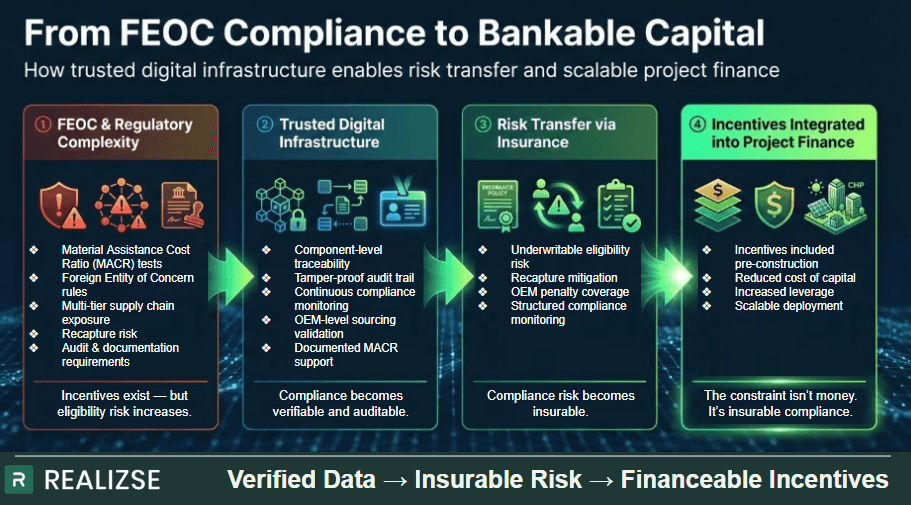
Realizse integrates passport data directly into insurance underwriting. This enables:
Transfer of eligibility and recapture risk
Insured incentive proceeds
Integration of credits into project finance structures
Capital stack inclusion prior to construction
The telematics analogy applies here as well:
Just as insurers price vehicle risk using real driving data, we enable insurers to price incentive eligibility risk using verified supply chain and compliance data.
When FEOC compliance is digitally verified and continuously monitored, insurers can underwrite that risk — and capital providers can finance against it.
Extending Protection to OEMs
The new FEOC regime also creates exposure for equipment manufacturers.
OEMs face:
Potential disqualification of projects using their equipment
Loss of market share due to compliance uncertainty
Reputational risk
Downstream recapture exposure
By integrating Digital Product Passports at the OEM level:
Manufacturers can provide compliant, traceable components
Risk of penalties and disqualification can be mitigated
Insurance solutions can be structured around component compliance
Developers gain confidence in procurement decisions
This creates alignment across the ecosystem:
OEM → Developer → Insurer → Capital Provider
All operating on shared, verifiable data.
The Policy Signal Is Clear
Treasury’s FEOC guidance signals a structural shift:
Clean energy incentives are no longer just policy tools.
They are regulated financial instruments with supply chain compliance attached.
In this environment:
The constraint isn’t money.
It’s insurable, verifiable compliance.
As compliance complexity increases, trusted digital infrastructure becomes foundational to deployment at scale.
The U.S. Treasury and IRS recently released Notice 2026-15, providing initial guidance on the “Foreign Entity of Concern” (FEOC) provisions under the One Big Beautiful Bill Act.
The notice outlines how projects must evaluate whether they have received “material assistance” from prohibited foreign entities in order to remain eligible for key federal incentives, including:
§45Y Clean Electricity Production Credit
§48E Clean Electricity Investment Credit
§45X Advanced Manufacturing Credit
While the credits remain available, the compliance bar has materially increased.
What the IRS Notice Does
Notice 2026-15 introduces interim guidance and safe harbors for determining whether a project or component violates the prohibited foreign entity rules.
Key elements include:
A new Material Assistance Cost Ratio (MACR) test
Definitions of prohibited and foreign-influenced entities
Documentation expectations tied to component sourcing
Interim safe harbor tables for calculating compliance
In practical terms, this means:
Developers must trace component sourcing more precisely
Manufacturers must document ownership and influence structures
Taxpayers must be able to substantiate compliance under audit
Recapture risk increases if compliance cannot be proven
The policy objective is supply chain security.
The market impact is heightened compliance risk.
The Real Challenge: It’s Not Just Eligibility — It’s Verifiability
Most clean energy projects now involve:
Multi-tier global supply chains
OEM components sourced from multiple jurisdictions
EPC contractors across multiple entities
Layered federal, state, and utility incentives
The FEOC regime doesn’t just require compliance.
It requires provable, auditable compliance over time.
Without verifiable traceability:
Incentive proceeds may be excluded from financing
Insurers may refuse to underwrite eligibility
Tax equity and direct pay investors may discount value
Recapture risk increases
In other words, incentives remain available — but they are no longer automatically bankable.
Why Digital Product & Project Passports Matter Now
At Realizse, we have built cryptographic, tamper-proof Digital Product and Project Passports specifically to operate in this new regulatory environment.
Our passports function as digital twins of clean energy assets and components — anchoring verified supply chain, sourcing, and compliance data to immutable records. The framework is architected to align with emerging global standards, including the EU Digital Product Passport (DPP) requirements, which are setting a precedent for traceable, verifiable product-level compliance across markets.
Our passports:
Anchor component-level data to cryptographically secure records
Create an immutable digital twin of the asset and its supply chain lineage
Track OEM sourcing and foreign influence exposure
Maintain continuous compliance documentation across the project lifecycle
Provide a tamper-proof, auditable compliance record
For FEOC compliance, this enables:
Traceability of components through multi-tier suppliers
Documentation of ownership and foreign influence thresholds
Evidentiary support for Material Assistance Cost Ratio (MACR) calculations
Continuous monitoring throughout the statutory recapture period
This is not simply documentation storage.
It is a cryptographically verifiable compliance infrastructure.
In an environment where eligibility can determine the viability of an entire financing structure, the result is not just data — it is a defensible framework of trust.
From Compliance to Risk Transfer
Compliance alone does not unlock capital.
Compliance must be insurable.
Realizse integrates passport data directly into insurance underwriting. This enables:
Transfer of eligibility and recapture risk
Insured incentive proceeds
Integration of credits into project finance structures
Capital stack inclusion prior to construction
The telematics analogy applies here as well:
Just as insurers price vehicle risk using real driving data, we enable insurers to price incentive eligibility risk using verified supply chain and compliance data.
When FEOC compliance is digitally verified and continuously monitored, insurers can underwrite that risk — and capital providers can finance against it.
Extending Protection to OEMs
The new FEOC regime also creates exposure for equipment manufacturers.
OEMs face:
Potential disqualification of projects using their equipment
Loss of market share due to compliance uncertainty
Reputational risk
Downstream recapture exposure
By integrating Digital Product Passports at the OEM level:
Manufacturers can provide compliant, traceable components
Risk of penalties and disqualification can be mitigated
Insurance solutions can be structured around component compliance
Developers gain confidence in procurement decisions
This creates alignment across the ecosystem:
OEM → Developer → Insurer → Capital Provider
All operating on shared, verifiable data.
The Policy Signal Is Clear
Treasury’s FEOC guidance signals a structural shift:
Clean energy incentives are no longer just policy tools.
They are regulated financial instruments with supply chain compliance attached.
In this environment:
The constraint isn’t money.
It’s insurable, verifiable compliance.
As compliance complexity increases, trusted digital infrastructure becomes foundational to deployment at scale.
